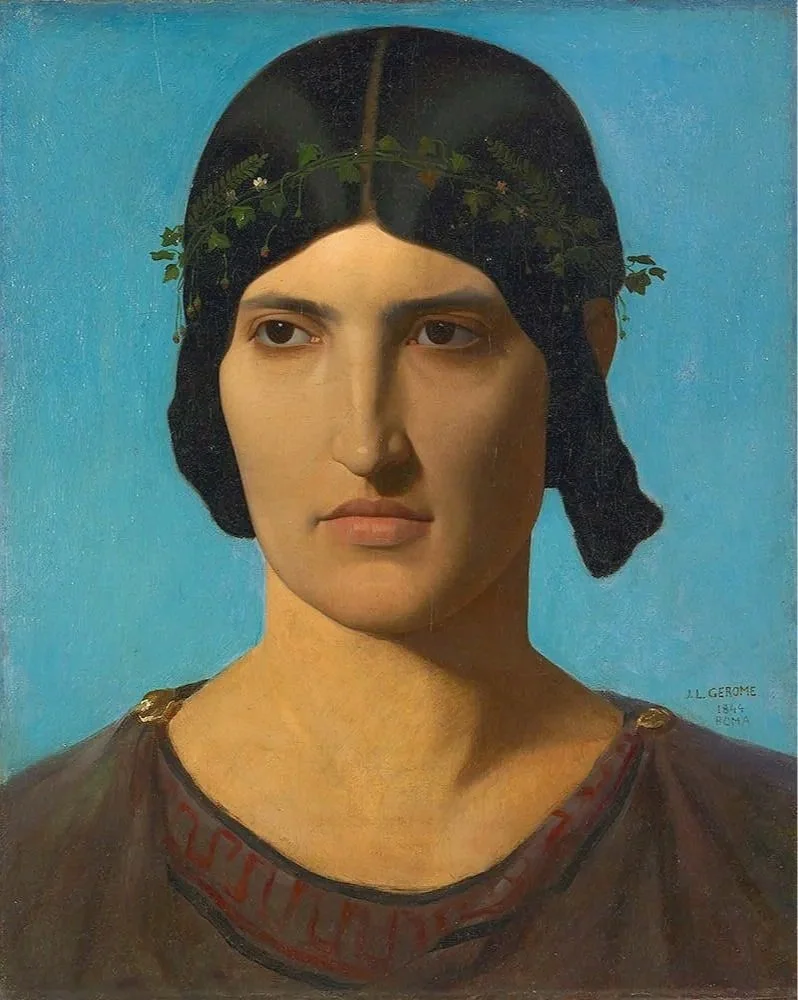
Jean-Léon Gérôme, Portrait of a Roman woman,1844.
“What transforms this world is - knowledge. Do you see what I mean? Nothing else can change anything in this world. Knowledge alone is capable of transforming the world, while at the same time leaving it exactly as it is. When you look at the world with knowledge, you realize that things are unchangeable and at the same time are constantly being transformed.”
Yukio Mishima, (1925-1970)
Have we ever truly examined what we hear, or do we just hear what we were taught?
EuMuse’s proposition is that listening (like a virtue) can be taught. The solid ground of data and the undeniable power of the invisible capacity of music can enforce an aspirational narrative of what progress could and should look like. It calls for a reframing of development as flourishing with all things wise and beautiful.
This is not about belief. It is about evidence, curiosity, learning, re-learning, and staying open to what the data reveals.
True understanding/knowledge happens through attunement, not only through analysis. EuMuse work is therefore less a theory of music and more a musicalization of life itself. It begins not in mastery, but in an exposure.
The more conscious and wider the life basis of music, the more beautiful will be the blossoming of its potential and creativity. “Thus, the task is not so much to see what no one yet has seen, but to think what nobody yet has thought about that which everybody sees.”

William Merritt Chase Memories, 1910.
“Thus, the task is not so much to see what no one yet has seen, but to think what nobody yet has thought about that which everybody sees.”
Arthur Schopenhauer, (1788-1860), Parerga und Paralipomena
Musical compositions are not single-frequency events. They are multi-layered information architectures. A musical instrument does not generate isolated frequencies. A single vibrating string simultaneously produces a fundamental tone, harmonic overtones, transient resonances, and dynamic interactions with surrounding frequencies. Music is therefore not a collection of independent sounds but a sophisticated hierarchy of organized oscillations evolving through time.
EuMuse proposes that this principle extends beyond acoustics into biological information processing. Music may be understood as hierarchically organized acoustic information—an architecture built from frequency, rhythm, interval, timbre, harmony, temporal expectation, repetition, variation, and dynamic change. These structural elements collectively form patterns capable of interacting with the perceptual and physiological systems of the listener.
EuMuse work aims to imbue philosophical concepts with life, correctness, and concreteness; have knowledge go through the process, and make it actionable.
In this endeavor, I have neither a preference solely for physical or natural-scientific facts nor for exclusively aesthetic aspects. It is my aim to strive for an integration of science, philosophy, and art with respect to continuous curiosity, unprejudiced viewing, and deepened questioning. Therefore, EuMuse will consider a great number of thoughts and various perspectives from these diverse areas.
It is my hope that as you ponder these thoughts, historical details, scientific data, and fascinating images, in all their myriad layers and multifaceted richness, the integrity inherent in all of these subjects will become apparent to you.

Argun Ivan Portrait of an unknown peasant woman in Russian costume, 1784
“Be. And, at the same time, know what it is not to be. The emptiness inside you allows you to vibrate in full resonance with your world. Use it for once.”
Rainer Maria Rilke (1875-1926), The Sonnets To Orpheus: Book 2: XIII
EuMuse and the Science of Organized Sound: From Quantum Vibrations to Biological Intelligence
Degradation of the natural world, changes in soundscape (a combination of human-made sounds-antrophony, sounds made by living animals – biophony, and geophony – non-biological natural sounds), and scientific research presenting historical and musicological substance filtered through structurally biased, resource-limited sources may increase a systemic risk to human prosperity.
If we are not knowledgeable about structural features of systems that optimize for appeal and plausibility rather than truth and beauty, we may face the prospect of a stupidity so sophisticated that it can become indistinguishable from intelligence.
Carlos Sanez de Tejada Girl seen from behind, Luisita, 1917.
“One does what one is; one becomes what one does.”
Robert Musil, (1880-1942)
True listening is an act of resonance. It requires active, conscious listening and deep attention - so that the melody and rhythm of another person, an idea, or nature can echo within them. Revisit - https://www.eumuse.com/blog/the-lost-art-and-music-of-childhood
By stepping out of the frantic, linear rush of digital time and entering a musical, cyclical framework of time, humans can retune their fractured psyches to a healthier, more organic pace.
The Unified Matrix of Scientists Musical Thinkers
This structural exploration of music reveals how the world's most celebrated polymaths used music not as an amusement or pleasant escape, but as an essential engine for their scientific discoveries and philosophical frameworks. They all treat music not as a mere human art form but as an architectural blueprint for how the self connects to the cosmos and universal harmony as the fundamental organizing principle of creation. Revisit - https://www.eumuse.com/blog/beyond-algorithms-cultivating-human-flourishing-for-ai-safety
Rudjer Boskovic (Ruđer Bošković), an 18th-century polymath, physicist, mathematician, astronomer, philosopher, diplomat, poet, and theologian, in his masterwork, Philosophiae Naturalis Theoria (Theory of Natural Philosophy, 1758), proposed that all physical phenomena in nature could be reduced to a single law governing forces between discrete, indivisible points. Much like the harmonic nodes and anti-nodes of a vibrating musical string, his mathematical models helped bridge the Newtonian mechanics of moving bodies with the wave mechanics used to study string vibration, acoustic resonance, and pitch. Bošković argued that human perception of beauty —whether in geometric patterns, visual color, or musical harmony—stems from recognizing simple mathematical relations and structural equilibrium in nature.

R. Edge Pine, Rudjer Boskovic, 1760.
“Prejudice for regularity and simplicity is a source of error that has only too often infected philosophy.”
Rudjer Boskovic, (1711-1787), Theory of Natural Philosophy (1758)
Nikola Tesla openly admired Rudjer Boskovic and considered him a visionary precursor to modern physics. Tesla perceived the universe not as an empty void of rocks but as a vast cosmological symphony. To him, electrical engineering and musical composition were guided by the exact same mathematical laws. At the absolute center of this vision was the concept of resonance—a principle fundamentally tied to both physics and music.
Nikola Tesla modeled his electrical innovations directly on the physics of acoustics, bridging acoustic wave phenomena and electromagnetic power. Just as sympathetic resonance allows a 440 Hz tuning fork to vibrate a silent piano's A4 string across open air, Tesla engineered wireless power transmitters and receivers tuned to match the exact same electrical frequency, allowing energy to transfer without physical wires. Furthermore, much like how a violin’s hollow wooden body amplifies the quiet vibration of a plucked string, Tesla replaced heavy iron transformer cores with an open-air core in his Tesla Coil—allowing secondary electrical circuits to naturally resonate, compound, and amplify modest input voltages into millions of volts of discharging energy.
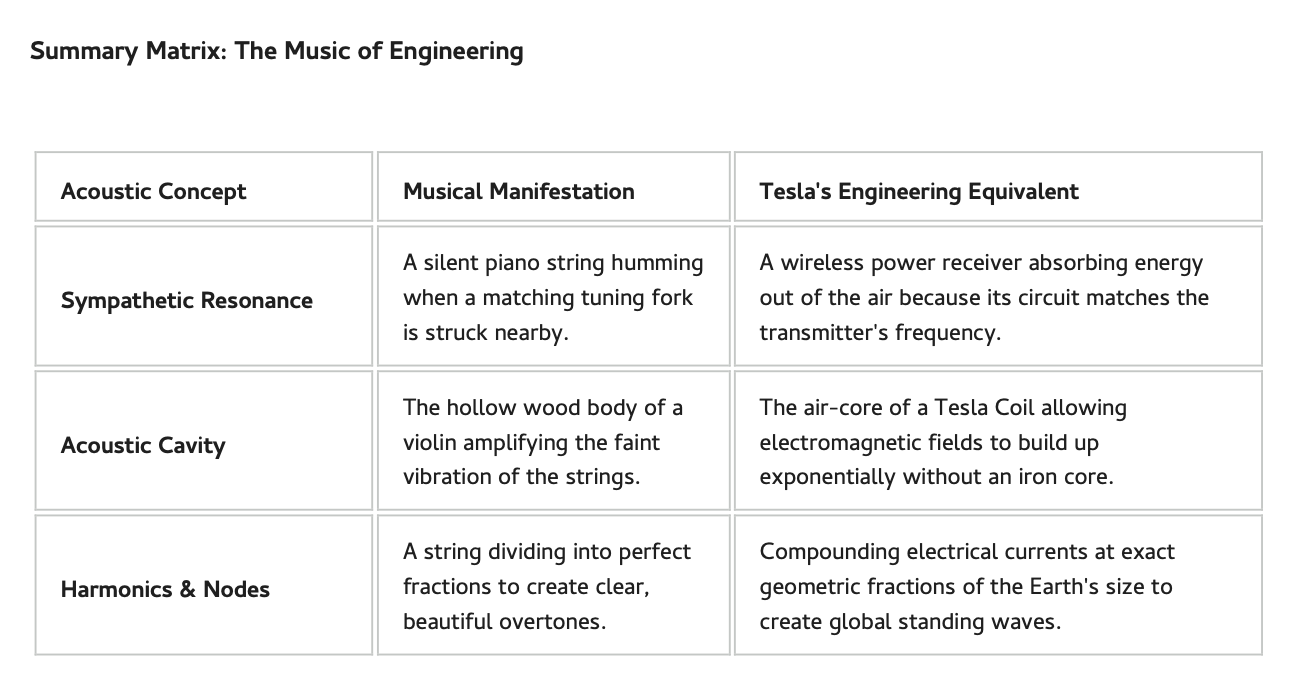
Renaissance of Resonance
Music, understood as intelligently organized sound and temporal architecture, is therefore more than an artistic language; it exemplifies how patterned vibration can encode, preserve, transfer, and transform information across physical and biological systems.
Structure, rhythm, harmonic organization, and resonance are fundamental organizing principles of complex systems—from quantum devices to living organisms.
In the 21st century, it was the Nobel laureate Frank Wilczek who claimed that the fabric of reality comes about by harmonic relations of discrete wave frequencies displaying beautiful patterns, among others reflected in the color spectrum. Roger Penrose went even deeper by claiming that consciousness in the brain arises from a sort of resonance of tubulin proteins to produce neuronal communication with vibratory ripples of the supposed smallest scale in the known universe: the Planck scale. In fact, quantum physicists frequently use musical analogies precisely because music is the audible manifestation of this concept.
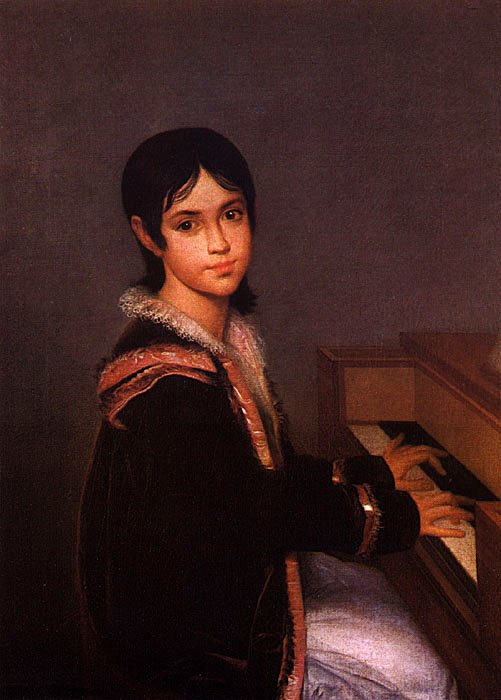
Domingos Sequeira, Mariana Benedita Sequeira,1822.
“Yet how strange a thing is the beauty of music! The brief beauty that the player brings into being transforms a given period of time into pure continuance; it is certain never to be repeated; like the existence of dayflies and other such short-lived creatures, beauty is a perfect abstraction and creation of life itself. Nothing is so similar to life as music.”
Yukio Mishima, (1925-1970) The Temple of the Golden Pavillon
A recent remarkable breakthrough from ETH Zurich (Swiss Federal Institute of Technology) has introduced a new way of thinking about computation. Instead of relying on conventional electromagnetic memory, physicists have demonstrated a quantum computer architecture that stores information as tiny mechanical vibrations within microscopic resonators. Much like the strings of a violin, these resonators vibrate in multiple modes, with each vibration encoding and preserving information. Although these frequencies exist far beyond the range of human hearing, they reveal a profound scientific principle: organized vibration can serve as a medium for storing, processing, and transforming information.
While this discovery belongs to the field of quantum engineering, its broader implications extend well beyond computing. It reinforces a principle that has quietly echoed through philosophy, music, mathematics, and medicine for more than two millennia—that structured vibrations are not merely physical phenomena but fundamental organizers of complex systems.
This principle lies at the heart of EuMuse, a scientific framework that investigates music not simply as an art form or entertainment but as an intelligently organized system of frequencies capable of influencing human biology, cognition, and emotional well-being.
Importantly, this perspective does not suggest that the human brain functions as a quantum computer or that music exerts quantum effects on biology. Rather, the ETH findings illustrate a broader scientific insight: vibration itself can act as an efficient carrier and organizer of information. EuMuse explores how carefully designed acoustic structures interact with the rhythmic organization already present within human physiology through mechanisms studied in neuroscience, psychology, acoustics, and systems biology.
This distinction marks an important departure from conventional approaches to music and health. Customarily, music therapy often begins with subjective questions such as, “What music helps people relax?” EuMuse instead asks a more fundamental scientific question: Which measurable structural properties of music produce predictable biological and psychological responses?
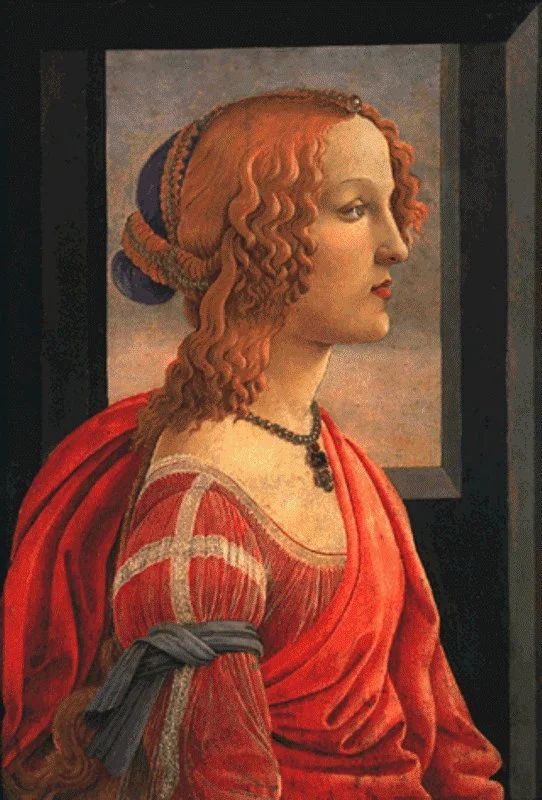
Sandro Botticelli Simonetta, 1480-1485
“The secret of all victory lies in the organization of the non-obvious.”
Marcus Aurelius (121 – 180AD)
Rather than classifying music by genre, artist, or widely “accepted” preference, EuMuse investigates objective musical variables, including rhythmic complexity, harmonic organization, spectral balance, melodic predictability, intervallic relationships, temporal symmetry, and acoustic entropy. These parameters can be measured, modeled, and tested against physiological outcomes such as emotional regulation, cognitive performance, attention, autonomic balance, and stress reduction.
Centuries-Old Intellectual Tradition and New Scientific Frontiers
This research philosophy forms the basis of Goal-Oriented Music Listening (GoML), EuMuse’s system that treats music as a precision-designed intervention rather than passive entertainment. Just as architecture shapes movement through physical space, musical architecture may influence the organization of perception, cognition, and physiological regulation through carefully structured acoustic environments.
Future research may classify music according to its resonance profile rather than genre, mapping compositions by harmonic geometry, temporal organization, spectral characteristics, and biological entrainment potential. Such frameworks could enable personalized acoustic interventions tailored to an individual’s cognitive goals, emotional state, or physiological condition, bringing precision medicine principles into the domain of music.

Frieda Kahlo, Self portrait in a velvet dress, 1926.
"Behind it all is surely an idea so simple, so beautiful, that when we grasp it – in a decade, a century, or a millennium – we will all say to each other, how could it have been otherwise? How could we have been so stupid for so long?"
John Archibald Wheeler, (1911-2008) How Come the Quantum?"
Behind It All Is an Idea Simple and Beautiful
For EuMuse, this realization reinforces a centuries-old intellectual tradition while opening new scientific frontiers. Music emerges not merely as culture or art, but as a sophisticated language of organized frequencies whose mathematical structure, temporal dynamics, and informational architecture may help explain its profound influence on the human organism.
As quantum technologies increasingly demonstrate the computational power of vibration, EuMuse seeks to explore an equally compelling question: how can intelligently organized sound be harnessed to advance human health, cognition, emotional balance, education, and flourishing? The answer may define one of the most promising interdisciplinary frontiers of the twenty-first century, where musicology, neuroscience, information science, psychology, acoustics, and systems biology converge around a common principle—that organized sound is not only something we hear but something through which living systems can perceive, adapt, and thrive.
Marina de Moses
Rudjer Boskovic and Luka Sorkocevic were part of the same intellectual network of scientists, philosophers, and diplomats from the Republic of Ragusa (today Dubrovnik, Croatia). Their circles included European figures such as Voltaire, d’Alembert, the Bernoullis, Metastasio, Haydn, and Gluck.