
Valentin Serov, Children-Sasha and Yura,1899.
“An education capable of saving humanity is no small undertaking. It involves the spiritual development of man, the enhancement of his value as an individual, and the preparation of young people to understand the times in which they live.”
Maria Montessori (1870-1952)
EuMuse Practical Wisdom
In resonance with Aristotle’s telos - wisdom is not for theoretical debate but for practical application - EuMuse aims to illuminate many dimensions of music listening and practice. Every single thought, art image, and musical piece is my humble creation of being brought together under the power of Beauty.
Why the EuMuse Model Matters Today

Diego Velazquez, Portrait of a little girl,1660.
“Minds, however, are conquered not by arms, but by love and nobility.”
Baruch Spinoza (1632-1677)
In a world dominated by screens, fast media, information overload, and fragmented attention, the EuMuse balanced model re-centers childhood around embodied rhythm, language depth, social connection, emotional intelligence, and creative agency, preserving inner capacities that digital consumption alone tends to erode.
We would like all children to have a chance to grow up with their attention spans and mental health intact, i.e., to be able to focus, to acquire knowledge, and to achieve their maximum potential. I think that should be every society’s aim.
Regrettably, the evidence shows that the digital destruction of childhood is a crisis we have to face if we are to have responsible, healthy, happy, and functioning future citizens.
How will children so constantly but artificially stimulated ever learn to think, imagine, create, or just enjoy being still?
Tech as a Tool, Not a Master
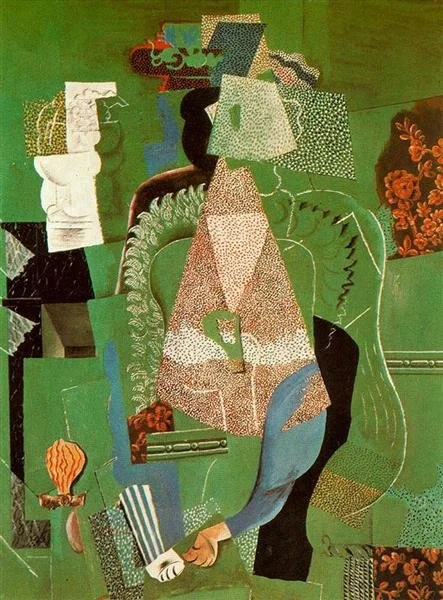
Pablo Picasso, Portrait of a young girl, 1914.
In the Theory of Colours, Goethe warns that mechanical tools produce dead, abstracted knowledge unless anchored by lived experience.
Technology should be used intentionally and moderately, and not as a default replacement for traditional methods. Recently published research highlights clear scientific evidence that tools impair rather than enhance learning.
For example, the brain learns deeper, slower and more permanently when a child writes by hand. Not types, not taps, not swipes. Handwriting builds memory, focus and real understanding and encodes information in a way screens cannot match. Books calm the nervous system. They help information sink in instead of slide past.
Across civilizations, major thinkers recognized a tension between inner cultivated memory and external technological memory. A text divorced from memory becomes mere information, not living knowledge.
The Myth of Thamus and Theuth predicts the current AI moment: the risk that tools meant to enhance the mind could replace the deeper cognitive, emotional, and musical capacities they were meant to support.
Theuth, an Egyptian god-inventor (associated with number, geometry, astronomy, and writing), proudly presents his inventions to King Thamus. When Theuth claims that writing will strengthen memory and wisdom, Thamus disagrees: writing will not give memory, but remindfulness; not wisdom, but the appearance of wisdom.
He predicts that: 1. People will outsource memory to external tools. 2. They will appear knowledgeable without genuine understanding. 3. The technology will reshape the mind more than users expect.
This makes the myth one of the earliest reflections on cognitive offloading and the cultural impact of new media.
Today’s artificial intelligence, digital interfaces, and algorithmic sound environments repeat the same pattern. These tools expand knowledge access but risk weakening mental discipline, sensory attention, and embodied memory. What writing was for Plato—externalized cognition—AI is for the contemporary world: an externalized meta-mind. It remembers, retrieves, organizes, and interprets. The danger lies not in its power but in the passive, unexamined dependence it encourages. Without inner cultivation, users may possess endless data yet little understanding. The myth warns not against the tool, but against uncritical adoption.



Beauty Educates Character Before Reason
Ugliness for Plato is not aesthetic only – it represents disorder, excess, and moral confusion. Across eras, beauty, harmony, and well-formed music were understood as the antidote to cognitive and cultural disorientation. As the modern world becomes louder, faster, and more externally mediated, the ancient warning becomes newly relevant: what we entrust to our tools, we cease cultivating within ourselves.
Systematic reviews of noise and cognition conclude that sound environments that are loud, unpredictable, or speech‑masking - conditions common in some media‑saturated homes, classrooms, and entertainment spaces — can capture attention, reduce concentration, and impair executive functions in children.
The mechanisms described (intensity, tempo, spectral density, and unpredictability) provide a plausible pathway by which synthetic, high‑arousal auditory environments could contribute to stress, sleep problems, and reduced quality of interaction, particularly for younger or more sensitive children.
Research highlights that high‑volume listening (often via commercial pop/electronic dance music through headphones) raises the risk for hearing damage, attention diversion, addictive‑like overuse, and negative mood when music is tied to themes of violence, discrimination, and despair. Repeated exposure to emotionally intense or negative‑themed music can shape or blunt children’s emotional responses and may reinforce anxiety, anger, or sadness in vulnerable youth.
Exposing Children to Music and Beauty

Music is not a neutral background but a continuous educator of the child’s brain and heart, either tuning neural ensembles toward beauty and harmony or drumming them into distraction and ugliness.
Music and rhythm are among the strongest scientifically validated tools for memory, literacy, emotional intelligence, language skills, attention, creativity, social cohesion, executive function, and metacognition.
Highly repetitive music decreases sustained attention (“attentional fatigue”), and digitally compressed sound increases physiological stress (e.g., increased cortisol, heart rate variability dysregulation).
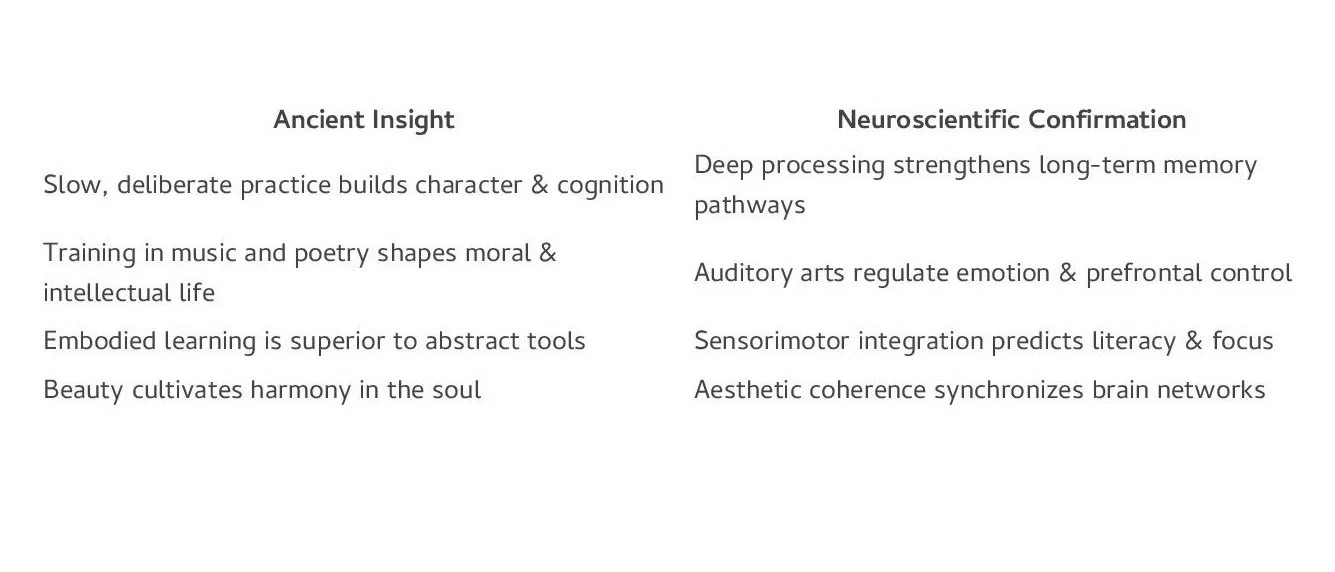
Modern neuroscience supports the same principles found in Plato, Confucius, and/or Renaissance educators:
The Legitimate and Important Role of Knowledge in Music Appreciation

Nicolas Tournier. Jeune Homme jouant du cornet à bouquin, 16/17th century
“One has no right to love or hate anything if one has not acquired a thorough knowledge of its nature. Great love springs from great knowledge of the beloved object, and if you know it but little, you will be able to love it only a little or not at all.”
Leonardo da Vinci
Socrates viewed ignorance as the root of evil. He believed that the greatest danger to society was not ignorance itself but the illusion of knowledge. Just as one cannot love if one is not acquainted with the lovable object or person, so we cannot appreciate beauty unless we are acquainted with it.
One can then begin to realize that music identity or “preference” for certain music piece/style depended not upon one’s beliefs (inherited or manufactured), but it actually depended on how much attention one has paid to things that were other than “his-her” music identity. And as one deepens this intentionality and attention, one starts to broaden and deepen the sonic horizon and the sense of the music world.
Prejudices Can Prevent Us From Perceiving a Truth; They Can Also Bar Our Aesthetic Perception
“Liking” of a musical piece
A music that is neither truly great nor sublime can nevertheless give us a pleasant sensation (easily confused with beauty) because we are acquainted with it. Another artistic trap into which many of us fall is to judge a work of art according to the reputation of the artist.
EuMuse responds by re-establishing designed listening as a core human skill. Like the early Vedic chanters, who preserved entire cosmologies through disciplined rhythm; like the Greek educators who shaped character through musical modes; like the West African griots, custodians of collective memory, who preserved history in their bodies and voices; like the Chinese sages who aligned music with cosmic order—EuMuse works to rebuild the inner environment. The approach is not romanticized; it is deeply scientific. Music structured through measurable acoustic, physiological, and emotional principles becomes a tool for rebalancing autonomic function, restoring attention, and rebuilding embodied memory.
In this framework, AI is not the enemy—it becomes Theuth’s instrument used with Thamus’ wisdom. Technology organizes, supports, and delivers the EuMuse protocols, but the transformation happens within the listener: improved breath patterns, entrained neural rhythms, emotional clarity, and a renewed capacity for perceiving beauty. EuMuse emphasizes intentional use of music, not passive consumption; depth, not distraction; cultivated presence, not algorithmic drift.
By integrating ancient insights with contemporary science, EuMuse offers a new educational and therapeutic model where music is not entertainment but a cognitive, physiological, and cultural regulator. In a time when digital tools threaten to replace inner life, EuMuse restores the original purpose of music across civilizations: to tune the human being back into harmony, memory, and meaning.
We don’t need dramatic, heroic gestures to help create change. Simple acts, when performed by millions of people, can transform the world.
May we contemplate irreplaceable sources of life and inspiration. May we contemplate about how to raise happy, intelligent, and morally elevated children – because educating the mind without educating the heart is no education at all.
Marina de Moses